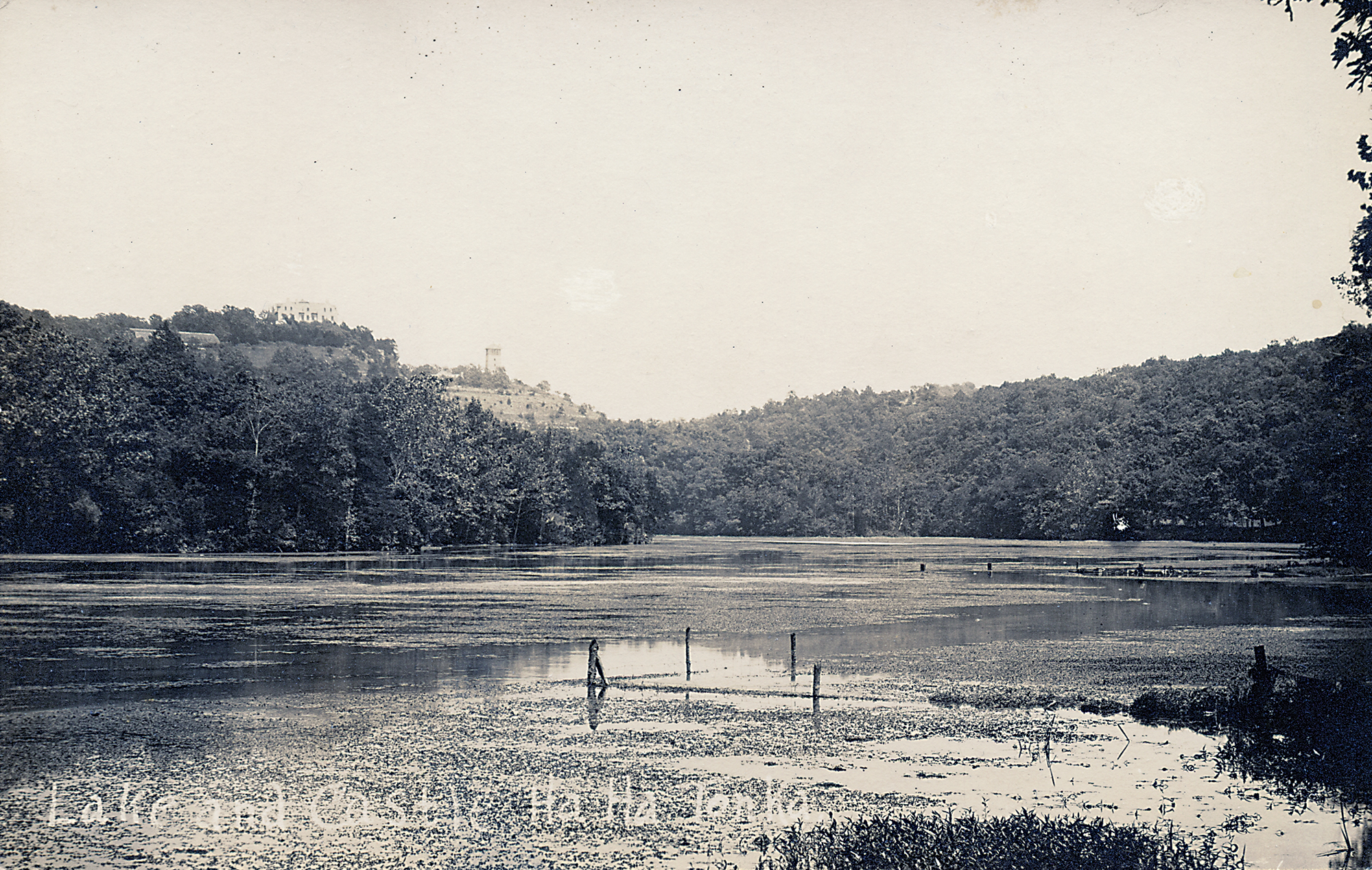
Ha Ha Tonka castle (upper right corner) seen from the banks of the spring branch. Photograph likely pre-1910.
The fanciful Indian name of the spring below the bluff is attributed to Col. R. G. Scott who came from Iowa to the Ozarks in the 1890s and partnered with R. D. Kelly to acquire the land around Gunter Spring. Col. Scott published the first article extolling Ha Ha Tonka’s natural wonders in an 1898 issue of Carter’s Magazine. In it he claimed the name is Osage for “Laughing Water.”
We don’t know the name of the photographer of this arty picture of the spring branch at Ha Ha Tonka with the young man (or possibly a young woman – what do you think?) gazing across the spring branch below the castle on the bluff, but we’re guessing its builder, Robert M. Snyder, commissioned the shot. (Snyder acquired the spring and lands from Col. Scott). If that’s so, we can date it before October 1906 when the Kansas City millionaire died in a freak car accident. “Robert M. Snyder has brains dashed out against an iron trolley pole,” wrote the Springfield News-Leader. (When did that kind of descriptive writing disappear from journalism?)
Most accounts of his death mention his “boodling” (bribery) problems. At trial he had been sentenced to five years. On appeal the court ordered a new trial, but prosecutors failed to pursue it. Surviving him were his widow and three sons. Not long before, another son had been murdered in Oregon where he was a suspect in a bank robbery. That son had already done time for highway robbery.
The spectacle of the unfinished castle inspired The Kansas City Journal to wax poetic in a 1907 article entitled, “HIS BARONIAL ESTATE: Wrecking of R. M. Snyder’s Ambition to Live in Splendor as a Feudal Lord.” It begins: “A pathetic monument to one man’s unachieved ambition is an unfinished baronial castle on the north slope of the Ozarks.”
Lake of the Ozarks backed up into the trout-stocked spring branch below the castle. The three sons unsuccessfully sued Union Electric, the builder of Bagnell Dam, for damages for their lost trout lake. Snyder’s boys finally finished the great stone mansion, and it functioned for a short time as a hotel before being destroyed by fire in 1942.
Five thousand acres of wild, undeveloped land the castle sits on was purchased by the state of Missouri in 1978 and made a state park. It’s an extreme example of karst topography, which includes the great spring, caves, sinkholes and a natural bridge, making it popular with hikers. The ruins of Snyder’s castle are now a tourist draw. An attempt to architecturally stabilize the gaunt walls was made in the 1980s, but access is limited now due to continued deterioration. Signage tells the tragic tale of the unlucky “boodler” at an observation point near the park’s office.
Vintage Images is a column we provide to River Hills Traveler, a monthly publication on the Missouri outdoors. Lens & Pen Press publishes all-color books on the Ozarks. Our book, “See the Ozarks: The Touristic Image,” showcases many of the primary tourist destinations across the Ozarks. It is available for $22.50 (10% off retail), postage paid. Click on Buy our Books