Sep 272025
 

The Weaver Brothers and Elviry were native Ozarkers whose hillbilly light comedy was successful on the vaudeville stage and in movies. Their “Hill-Billy Review” is shown in this 1930s press photo.

The Weaver Brothers and Elviry became headliners after World War I, and performed with top vaudeville names like Al Jolson, George Burns and Gracie Allen, Jack Benny and Beatrice Lillie. Elviry’s comic catchphrase was, “If I had my druthers, I druther…”  They starred in movies for Republic Pictures in the 1930s and ‘40s. Elviry (June Petrie) was born in Chicago but raised in rural Missouri. The brothers, Abner (Leon) and Cicero (Frank) Weaver were from Ozark, Missouri. They have their own Wikipedia page.

A staple of early Branson music shows was a rube or hillbilly comic. In recent years some shows have dropped that genre of humor. Much ink, and a little blood, has been spilled over classifying the natives of the Ozarks. Though the term “hillbilly” did not appear in print until 1900, early educated travelers found the character of the southern mountaineer a tad raw, but raw material for literature, nevertheless.

Leon was adept at mandolin, guitar, fiddle and handsaw, while Frank played novelty instruments including a spinning banjo and a one-man band. June could play piano, mandolin and ukulele.

When tourists found backwoods Ozarkers’ anachronistic lifestyle quaint, even reminiscent of our pioneer ancestors, they were deemed “hillfolk.” When locals resisted development, such as dams and highways or were disinterested in changing a vacationer’s flat tire in the rain, they were “hillbillies.”

In the 1930s and 1940s, hillbilly-ness was hot. Some of this was jokey, even demeaning, but many of the portraits of rural rubes were good-hearted. The audience for such fare brought with it a collective recent memory of rural poverty and the lifestyle it dictated. European immigrants and transplanted Okies alike had personal experiences — both positive and negative — with impoverished country life, as well Ozarkers. The hillbilly became a classic American stereotype. Ill-educated, musically talented, unintentionally funny, and fabulously indifferent to the disciplines of the workaday world, their corny predicaments delighted audiences across the land. Even in the Great Depression, their antics were worth the price of admission.

Check out  See The Ozarks: The Touristic Image.  for more information and gorgeous pictures of early tourism in the Ozarks


Jul 172025
 

Real photo postcard, circa 1910.

This circa 1910 unsent, real photo postcard shows a large family camping out in the woods. We assume it’s a family but the subjects are unidentified so no guarantee. Not that their scribbled title isn’t descriptive, but we wished we knew their names and where they came from. Sadly, we know nothing about the family, place or circumstance. These real photo postcards often have frustratingly specific images, with no written information. They were produced by local photographers or family members and not commercially available.

Still we can see that from three-year-olds to grandparents, no one stayed home. The young equestrian ladies are the only ones mounted, and they are sporting long guns. Females are often shown as active participants in Ozark fishing and hunting.

As for the steeds, according to Crystal’s brother, equine surgeon Dr. Jay Merriam, “The small middle one is probably a mule. The big one standing sideways on the left is probably a Mammoth Jack of a type well known in Missouri. When bred to a horse mare, they would produce a wonderful, large, strong mule that could provide for a family for 20+ years. A real prize. This family is going to prosper.”

Their rude lodging runs from several tents (one like a teepee) to a sawmill shack. The trees are bare and everyone wears a coat. It must be a winter hunt. The Ozarks as a sporting mecca goes way back in time.

Vintage Ozarks is a feature we provide to River Hills Traveler, a monthly publication. Our company, Lens & Pen Press publishes all color books on the Ozarks. James Fork of the White: Transformation of an Ozark River is a 352-page all-color book that looks at the effect of development on a famous float stream and our efforts to protect riverine resources. The book is available for $31.50 postage paid. Click on Buy  Our Books to order.

Jun 282025
 

Specialty crops like strawberries, apples and tomatoes, where produced in the hilly Ozarks. As early as the 1870s the rail corporations promoted the region as “the Land of Big Red Apples.”

Sportsmen and vacationers were not the only groups invited to come and see the Ozarks. The Frisco Line’s full-page ad in a 1912 Washington, DC, Star Sunday Magazine asked, “why don’t you take your family to live in the beautiful Ozarks?  A small farm in the Ozarks is the opportunity you need. Think what a wholesome, healthy life it would mean for your children. You can get a small place near good towns, and good schools, as low as $10 per acre.”

Laura Ingalls Wilder, author of the Little House books, and her husband Almanzo were typical of these late nineteenth- and early twentieth-century settlers. She and Manny bought their farm, Rocky Ridge, near Mansfield in 1894. They practiced progressive farming and she wrote her classic books on pioneer family life.

Through the decades, Ozarks promotional material often mixed appeals to both vacationers and would-be immigrants. Visitors today are seen as potential buyers of condos or second homes. After a lifetime as summer visitors, many people come to live in the region when they retire. Others, who spent their childhood in the Ozarks and their working lives in faraway cities, often return to their roots.

Vintage Ozarks is a feature we provide to the monthly publication, River Hills Traveler. Our company, Lens & Pen Press, publishes all color books on the Ozarks. This image is taken from See the Ozarks: The Touristic Image. The hardback, all-color book on early tourism in our region is sale priced at $22.50, postage paid.  Click on Buy our books .

Aug 092024
 

Real photo postcard, circa 1920. “Taking his medicine in the Ozarks, Anderson Missouri.” Note the long gun on the ground by his feet. This hunter was thirsty!

The spring-fed creeks and  of the Ozarks were promoted in tourism literature from the beginning. Claims were made that additional benefits came from bathing and drinking from the pure waters flowing throughout the region. These met with less success than the promotions of Eureka Springs, which had extensive infrastructure to accommodate upper middle-class travelers. Even when there was widespread faith in the healing properties of spring water, Eureka’s gracious accommodations, fine food, shopping, and sightseeing edged out other health resorts at Heber Springs and Sulfur Springs, Arkansas and DeSoto, Missouri.

There were claims, as this postcard shows, that you could quench your thirst drinking from a surface stream. Even back then, we suspect that was not always a good idea. Ozarks creeks and rivers were clear and relatively unpolluted, and promotion of river fishing was justified, but drinking directly from a stream would have been perilous.

Image courtesy of Lens & Pen Press. See The Ozarks: The Touristic Image, with an extensive section on Eureka Springs, is now available on our website at www.dammingtheosage.com for $22.50 (10% off retail price of $24.95), postage paid.

Sep 062023
 

Lead mine along Pearson Creek, circa 1900. Commercial extraction of lead here began in the 1840s and ended around 1920. Remnants of lead diggings can be seen in the hills along lower Pearson Creek.

In Schoolcraft’s 1819 account, A View of the Lead Mines of Missouri, he wrote, “On the immediate banks of James River are situated some valuable lead mines, which have been known to the Osage Indians and to some White River hunters, for many years.”

The young New York explorer repeatedly expressed astonishment at the clarity of Ozark streams. At his James River camp at the lead mine he observed lumps of ore “through the water, which is very clear and transparent.” Other Ozark regions had much vaster commercial lead deposits. These diggings along the James River left unsightly holes and the potential for lead contamination.

Dr. Robert T. Pavlowsky and his associates and students at Missouri State University’s Ozark Environmental and Water Resources Institute have investigated the effect of these old mines on water quality. They found lead contamination from mine waste has been stored in alluvial deposits of floodplains. Lead that washed into streams is now embedded in sediments in Pearson Creek and the James River. It will eventually degrade, but there is a danger if channel instability uncovers this mining-related metal contamination.


Taken from James Fork of the White: Transformation of an Ozark River, now on sale for $17.50 (half price) postage paid, at www.beautifulozarks.com

Mar 032023
 

Brooks Blevins lectures frequently after the publication of his many studies of the Ozarks.

5-Star Review of Brooks Blevins new book by Leland Payton

National and regional identities may not have disappeared but what defines a people and their relationship with place has undergone evolution. Colorful identities are challenged by the homogenization of modernization. In rural regions, more than in urban, lifestyle relates more to geographic specificities. A rural place’s reputation may not have been created by—or accurately reflect the perceptions of, its natives. Academic studies of the Ozarks are scarce compared to other regions of the U.S. Tourism and popular culture have largely shaped its image, but not always falsely, Blevins concedes.

Brooks Blevins’ latest take is Up South in the Ozarks. Subtitled, Dispatches from the Margins, Blevins challenges the overall accuracy of the place’s most dominant symbol, the hillbilly, but acknowledges that the definition of a region needs to account for its clichés. Curiously, many Ozarkers accept cartoonish rustic depictions. Professor Blevins melds academic expertise from many disciplines— an appreciation for folklore, familiarity with both literature and journalism—with the personal, insightful observations of a native son. His encyclopedic geographic and historical knowledge is delivered with humor and a talent for metaphor. Throughout he contrasts and compares this Midwestern river-cut uplifted plateau with both the Deep South and the Appalachian Mountains.

Missionaries and writers descended on the southern highlands of Appalachia before they came to save souls or describe the more isolated Ozarks. In the chapter, “A Time Zone Away and a Generation Behind,” he analogizes the Ozarks to a younger sibling: “You were never first, never original, never completely yourself. Even at school, your teachers knew you as your big brother’s little brother. If that’s your story, you know how the Ozarks feels.”

His chapter, “The South According to Andy,” makes the case that the 1960s TV show set in a fictional mountain south small town was a portrait well received by Ozarkers: “Andy’s South was not the South. It was a South. … It was a projection of something quite southern, even if not a complete portrait of the South.”

Dr. Blevins doesn’t idealize the Ozarks. He confronts the idea that the mountain south was exempt from the past racial prejudices that characterize the Deep South. In “Revisiting Race Relations in the Upland South,” he admits his earlier position based on that premise was wrong: “But the equation of a small Black population with a comparative degree of racial harmony has not always appeared so self-evident to scholars and observers of the South.” He follows facts down unmapped, rocky trails no matter where they lead.

A generational lag in scholarship he believes may be closing: “In 2010, Missouri State University established the region’s first Ozarks Studies minor for undergraduates. Five years later, the University of Arkansas Press launched a monograph series in Ozarks Studies. (They published this book). We may never be first in the Ozarks, but we get around to it eventually. Such is the life of a regional little sibling.”  Blevins is on the board of the Ozarks Studies Institute, an initiative of the Missouri State University Libraries. Dr. Blevins also teaches classes on Ozark history at MSU.

Up South in the Ozarks seeks the nuanced realities of a large, misunderstood region that is paradoxically both romanticized and maligned. Brooks Blevins cherishes the Ozarks and believes its story is worthy of an honest telling, quirky, droll, and marginal as its realities often are.

Available from the University of Arkansas Press, Amazon.com, and Barnes & Noble.

Feb 182021
 

Real photo postcard marked, “Osage River” and “Becraft Photog. (21).”

What in the world is that ball on a stick  doing in the middle of the Osage River, poking up from the bottom of this real photo postcard?

This enigmatic view is postmarked “Monegaw Springs Aug. 23, 1907.” It was addressed to Miss Mary Mifflin Kansas City, Mo: “Dear Sister, this is a splendid picture of the Osage. Having a royal good time. Am rather used to the strange country ways by now … lovingly, Edna.” “Strange country” indeed—what IS that ball on a stick?

Did surrealism, the art of incongruous imagery, hit the Ozarks a decade before the term was even coined in Paris? If you’ve got any idea what that ball and stick are please let us know at lensandpen@yahoo.com

We have half a dozen Becraft real photo postcards, mostly of Osceola and the upriver spa, Monegaw Springs. In our book Damming the Osage, we used a wonderful image of his showing a 68 lb. blue cat proudly displayed by two men and a boy on the streets of that old river town.

NOTE: In 1905 a group of Kansas City businessmen acquired the old Monegaw log hotel (once a favorite haunt of the James and Younger brothers while laying low from the law) and began development of a resort on the Osage. It’s entirely possible Miss Edna was a guest at the Monegaw Club.  Watch for a future post on the post-outlaw life of the old hotel in Monegaw.

Several Lens & Pen Press books discuss the evolution of the Ozark landscape and our effects on its rivers. Check out Damming the Osage which has an extended explanation of Monegaw Springs and its outlaw history. All our books are now on sale for half price, postage paid. Order on www.dammingtheosage.com

Feb 102021
 

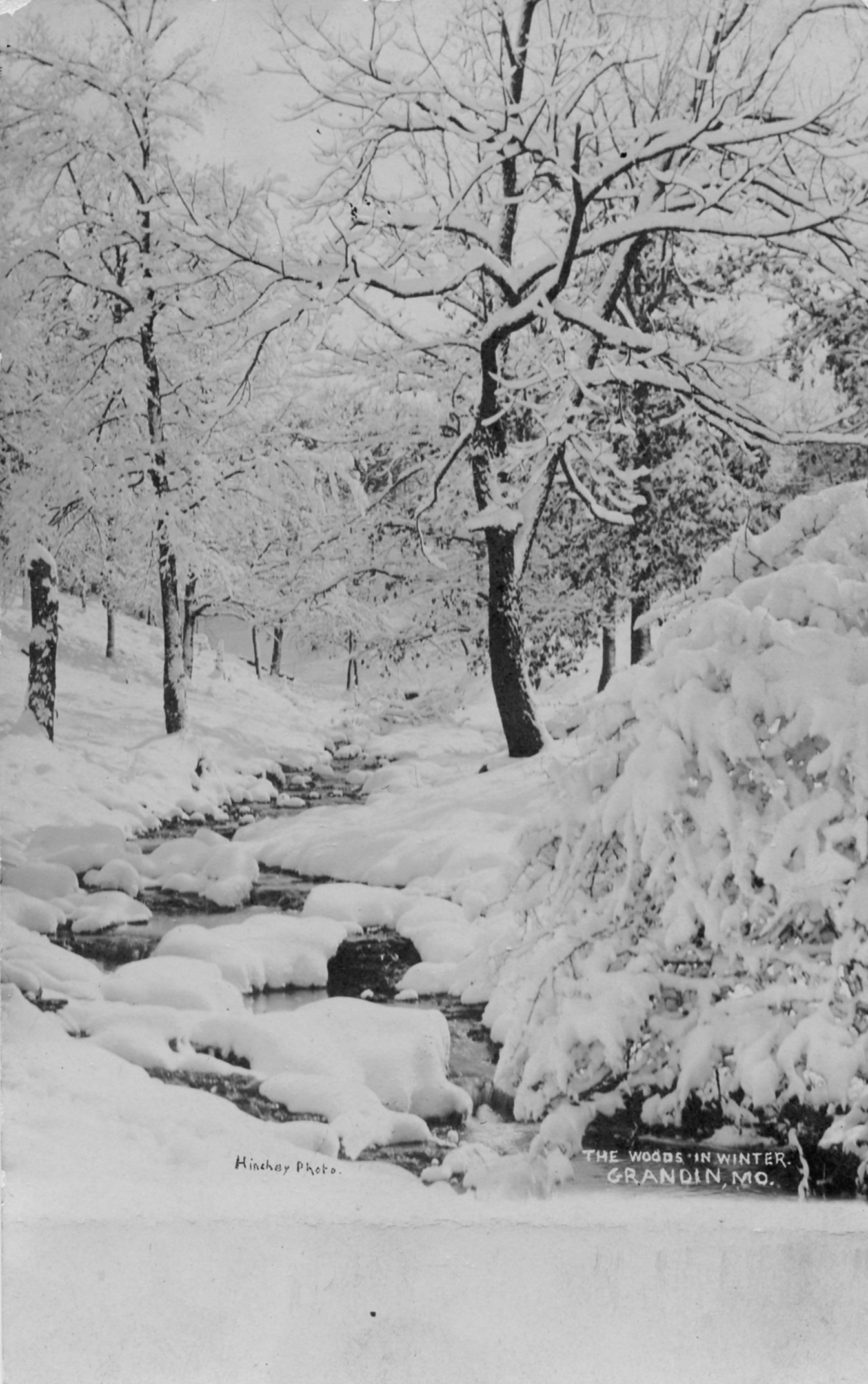
This seems an appropriate card to post this week as temperatures fall and freezing mist turns roads into treacherous slides.

Entitled “The Woods in Winter, Grandin, Mo. Hinchey Photo,” this toned real photo postcard is puzzling. When this photo was taken, Grandin was the largest sawmill operation in the world, yet this scene is anything but industrial. Pennsylvania capitalists created the Missouri Lumber and Mining Company and, with the help of thousands of mill hands, converted a large percentage of the virgin pine forests of the southeast Ozarks into dimension lumber. (See details of that industrial lumbering operation in our book, Mystery of the Irish Wilderness.) Presumably, the puny trees along the brook were safe from the sawmill blades. But who, in this nexus of industrialization, would be interested in a poetic snow scene?

R. E. Hinchey was the “official photographer” for several railroads. They produced heavily illustrated booklets on the Ozarks, which not only promoted farming, mining, and wood products but also portrayed the region’s natural beauty. This postcard image was likely an outtake from his assignment to depict the area for Frisco sales material.

Several Lens & Pen Press books discuss the evolution of the Ozark landscape and our effects on its rivers. Check out Damming the Osage and James Fork of the White on www.beautifulozarks.com All our books are now on sale for half price, postage paid. Order on www.dammingtheosage.com


Nov 142020
 

The holiday season is upon us all and BOOKS MAKE SPLENDID GIFTS!

We are pleased to offer a 50% discount on our current inventory with free shipping.
Click here to visit our storefront to order now.

Lover’s Leap Legends Price now: $17.50
James Fork of the White Price now: $17.50
Damming the Osage: Price now: $17.50
Mystery of the Irish Wilderness: Price now: $9.95
On the Mission in Missouri Price now: $10.50
The Beautiful and Enduring Ozarks Price now: $9.95
See the Ozarks: The Touristic Image Price now: $12.50

We have videos about our books on our Youtube channel.


Send check orders to:
Lens & Pen Press
4067 S. Franklin
Springfield, MO 65807

Sep 092020
 

Webb appears to have a tattoo on his left arm. We can’t quite make it out, but there’s a good chance he was in the Navy as military symbols were dominant motifs in ink then.

On the front of this real photo postcard, circa 1940, is written “H. P. Webb, Originator of “Missouri Mule.” We vaguely remember seeing these handmade souvenir mules in junk shops or antique malls in the past. After finding this postcard, if we see another one we’ll buy it.

The Missouri mule has faded from public memory. Mules, which are a sterile hybrid of horses and donkeys, were known for their strength, stamina, and intelligence – and for their willful obstinance, contrariness. Somehow this aligned with the popular image of Missourians and the mule was a symbol of rural Missouri. They are more a curiosity than a common farm animal today. Awareness of them has retreated. Locally produced souvenirware all but vanished in the 1950s with the availability of much cheaper Japanese giftware, some of which was hand-painted and quite attractive originally but became slurred as time went on. Locally made crafts are sold today as art, not souvenirs.

###

Lens & Pen books are available on this website, on amazon.com and at Barnes & Noble. You can see sample pages of our most recent book, Lover’s Leap Legends: From Sappho of Lesbos to Wah-Wah-Tee of Waco, on our website: hypercommon.com.

Lover’s Leap Legends won the bronze medal in the popular culture division of the 2020 Independent Publishers’ Book Awards, an international competition. This year there were entries from forty-four states, seven Canadian provinces and fifteen other countries.

James Fork of the White: Transformation of an Ozark River was a finalist in Regional Non-fiction in the 2019 Indie Book Awards. Lens & Pen Press’s earlier river book, Damming the Osage: The Conflicted Story of Lake of the Ozarks and Truman Reservoir, was awarded a silver medal by the Independent Publishers’ Book Awards in 2013.)